
SAP Integration (Proposed)

When a scan closes, the RFID middleware aggregates it into a business event and posts the resulting goods movement to SAP. This page defines the endpoints and fields SAP exposes and Geoplan RFID calls, the reverse of the rest of this reference, where clients call Geoplan.
Direction
Section titled “Direction”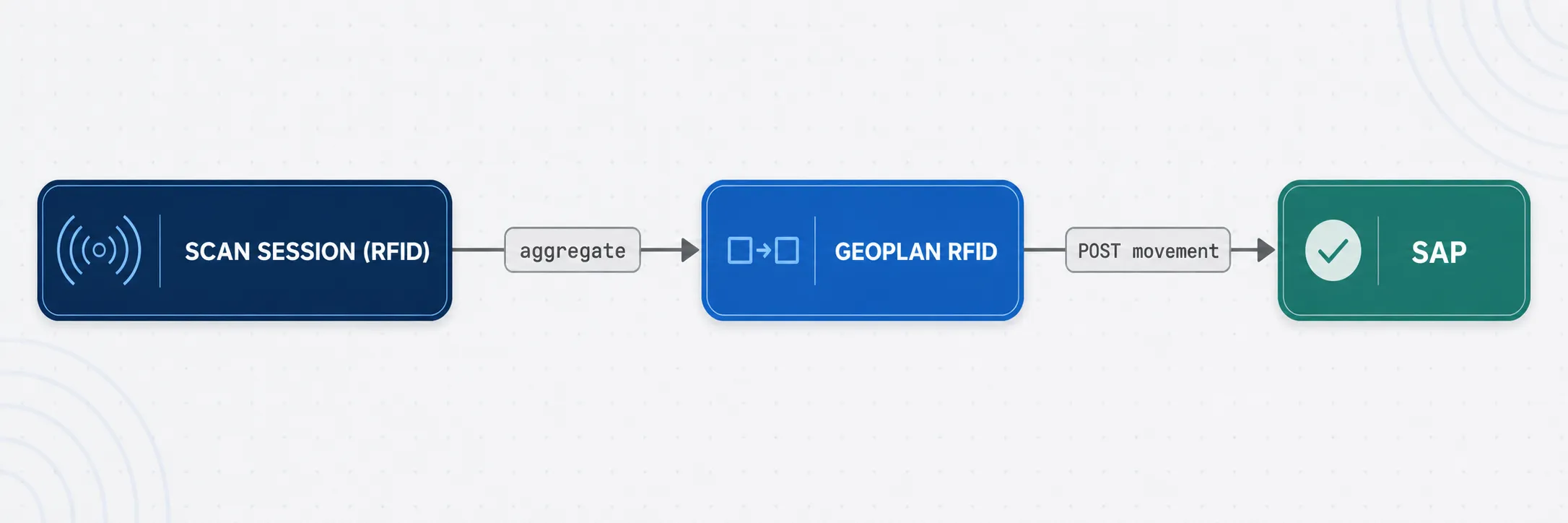
- SAP hosts the endpoints below. Geoplan RFID is the client.
- Base URL: SAP host, to be provided by SAP.
- Auth: SAP-defined (e.g. OAuth / mTLS / basic). Not the
x-api-keyused elsewhere in this reference. - Payloads are proposed as JSON. SAP may map fields onto its own objects (MM/SD/EWM).
Movements (core set)
Section titled “Movements (core set)”One POST per movement type, each mapping to a distinct SAP object. All four share the common envelope below.
| endpoint (SAP-hosted) | movementType |
SAP object |
|---|---|---|
POST /rfid/goods-receipts |
GOODS_RECEIPT |
Goods Receipt (PO / Inbound Delivery / ASN) |
POST /rfid/goods-issues |
GOODS_ISSUE |
Post Goods Issue (Outbound Delivery) |
POST /rfid/stock-transfers |
STOCK_TRANSFER |
STO Goods Issue / Receipt |
POST /rfid/inventory-adjustments |
INVENTORY_ADJUSTMENT |
Inventory Difference / Physical Inventory Doc |
More movement types (POS sale decrement, customer/vendor returns, store receiving) follow the same shape and get added as the scope firms up.
Request envelope
Section titled “Request envelope”Every movement POST sends the same body. movementType distinguishes them. The endpoint path is a convenience that mirrors it.
{ "movementType": "GOODS_RECEIPT", "documentRef": "PO-4500012345", "documentType": "PURCHASE_ORDER", "warehouseCode": "WH01", "scanSessionId": "38a7393e-7750-4437-9c0f-b69db6e247b5", "scannedAt": "2026-07-22T02:10:20.000Z", "lines": [ { "sku": "ZRA-FOO-OLI-40-036815", "gtin": "7067600196000", "quantity": 12, "epcs": ["3034F4A9…01", "3034F4A9…02"] } ]}Fields
Section titled “Fields”| field | type | required | RFID source / note |
|---|---|---|---|
movementType |
enum | yes | GOODS_RECEIPT | GOODS_ISSUE | STOCK_TRANSFER | INVENTORY_ADJUSTMENT. From the scan activity |
documentRef |
string | yes | SAP source doc no. (PO / Delivery / STO). RFID transactionReference |
documentType |
enum | no | PURCHASE_ORDER | INBOUND_DELIVERY | OUTBOUND_DELIVERY | STO | … |
warehouseCode |
string | yes | Plant / storage location the scan happened at |
scanSessionId |
uuid | no | RFID session, for traceability / idempotency |
scannedAt |
ISO-8601 | no | When the session completed |
lines[].sku |
string | yes | Resolved from scanned EPCs |
lines[].gtin |
string | no | |
lines[].quantity |
int | yes | Distinct EPCs scanned for the SKU |
lines[].epcs |
string[] | no | The EPCs behind the quantity, for audit |
Response
Section titled “Response”Same shape for all four endpoints.
{ "status": "POSTED", "sapDocumentNumber": "5000004567", "postedAt": "2026-07-22T02:10:25.000Z", "messages": [ { "sku": "ZRA-FOO-OLI-40-036815", "type": "WARNING", "text": "Posted with over-delivery tolerance" } ]}| field | type | note |
|---|---|---|
status |
enum | POSTED | FAILED | PARTIAL |
sapDocumentNumber |
string | the material / delivery doc SAP created |
postedAt |
ISO-8601 | |
messages |
array | per-line info / warnings / errors (sku, type, text) |
GET /rfid/documents: optional source document
Section titled “GET /rfid/documents: optional source document”Lets RFID pull the expected document before scanning, to validate scanned quantity against expected. Optional for the first cut.
| param | type | notes |
|---|---|---|
type |
enum | PURCHASE_ORDER | INBOUND_DELIVERY | STO | … |
ref |
string | the document number |
{ "documentRef": "PO-4500012345", "documentType": "PURCHASE_ORDER", "warehouseCode": "WH01", "lines": [ { "sku": "ZRA-FOO-OLI-40-036815", "gtin": "7067600196000", "expectedQuantity": 12 } ]}To confirm with SAP
Section titled “To confirm with SAP”- Auth scheme + base URL.
- Idempotency: an idempotency key (e.g.
scanSessionId) so a retry never double-posts. - Error semantics: partial-post handling, per-line vs whole-document rejection.
- Do batch / serial-managed materials need extra fields?
- Plant vs storage-location granularity for
warehouseCode. - Whether SAP would rather push documents to RFID than have RFID pull them via
GET /rfid/documents.
RFID-side prerequisites
Section titled “RFID-side prerequisites”For Geoplan to build the payload above, the middleware still needs to:
- Capture
warehouseCode. Not stored on a scan today. Add it to the session or derive it from the reader’s location. - Aggregate quantity per SKU. Resolve session EPCs to SKUs (via master data) and count.
- Map scan activity →
movementType, and carrytransactionReferenceasdocumentRef.